


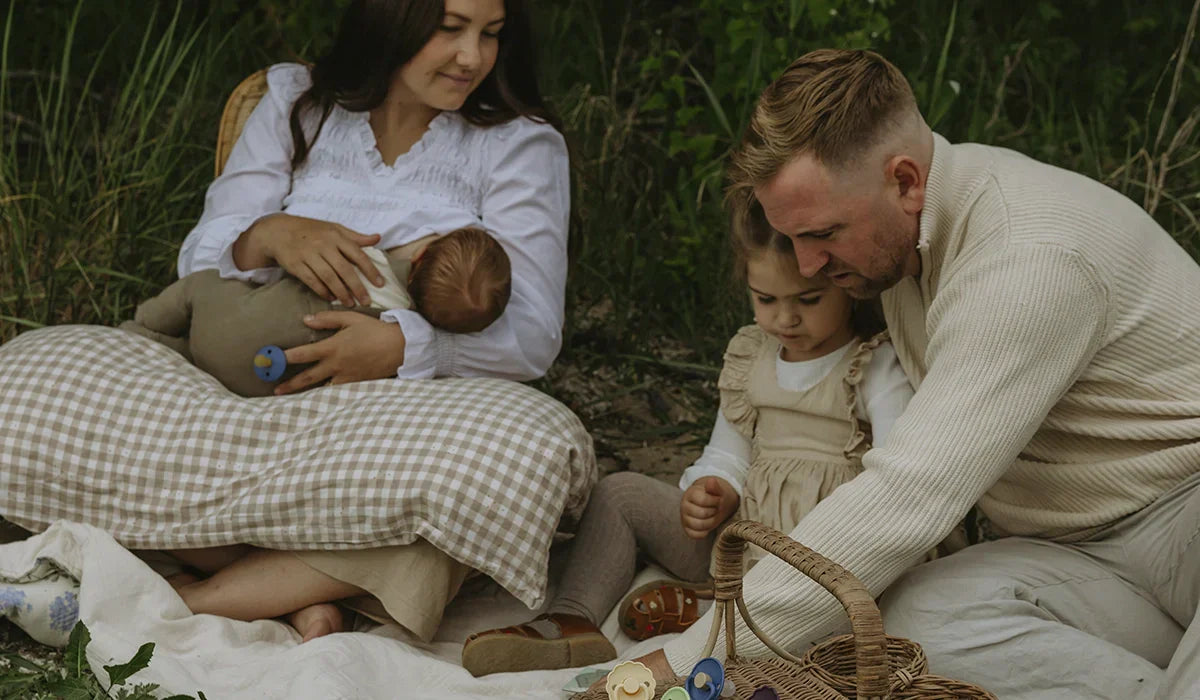
There are many benefits to offering your child a pacifier
The pacifier comforts, gives the child security and makes him relax. It strengthens the child's mouth and jaw muscles, while training the coordination of the jaw, palate, tongue and lips. It is good for both the child's breathing, eating and speech development.
So there are many good reasons to give your child a pacifier, but when is it appropriate to give the child a pacifier - and how can it affect breastfeeding?
Support breastfeeding with round teats
The general recommendation is to only introduce babies to pacifiers when breastfeeding is fully established. However, more and more professionals are moving away from this position and now recommend that you offer your child a pacifier from the start - as long as it is the right type. Here, only the classic round pacifier with natural rubber (latex) pacifier will last. The round pacifier is most reminiscent of a breast in both shape and material.
The explanation is that when the infant is nursing, it rolls its tongue up around the mother's nipple and creates a vacuum, which causes the milk to flow. When the child sucks on a round pacifier, it rolls the tongue in the same way. That is why many maternity wards provide round pacifiers already in the delivery room, and several children's chiropractors and maternity clinics recommend that babies get a round latex pacifier from the start to promote breastfeeding.
What is pacifier confusion?
Pacifier confusion typically occurs if the infant gets used to a flat pacifier – for example an anatomical or symmetrical pacifier – before he has full control of his sucking technique during breastfeeding. The flat pacifiers do not require the child to roll their tongue around the pacifier. Instead, the child presses the pacifier with a flat tongue and lips pressed together. If the baby tries to use this technique while breastfeeding, the milk will flow less, the baby will find it more difficult to eat, and breastfeeding may become painful for the mother.
How to avoid pacifier confusion?
If you wait to offer the baby a pacifier until breastfeeding is completely in place, you avoid the baby using the wrong technique during breastfeeding.
If you want your child to benefit from the many benefits of the pacifier earlier, you can confidently introduce the pacifier from the start - if you choose a round pacifier that supports breastfeeding, so that the child uses the same technique for both breast and pacifier.


